
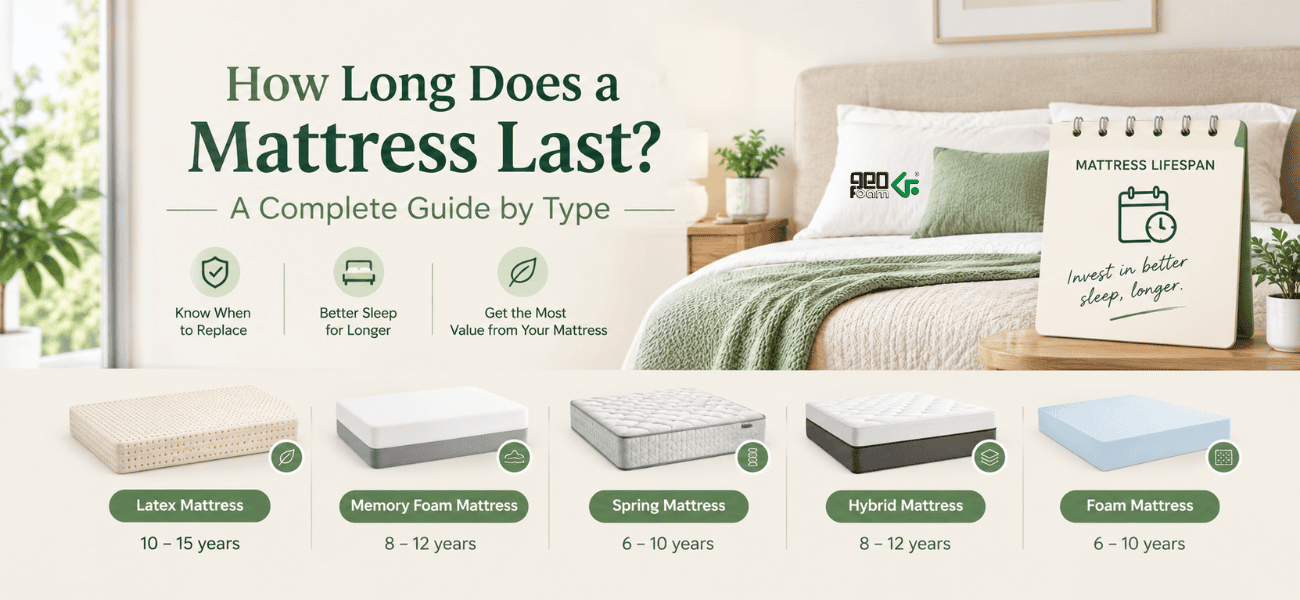
How Long Does a Mattress Last? A Complete Guide by Type
How long does a mattress last? Most mattresses last around 7 to 10 years, but the actual lifespan depends heavily on the materials, construction, usage and quality of the mattress.
A budget innerspring mattress may need replacing in six years, while a high-quality natural latex mattress can remain supportive and comfortable for 15 years or more.
Here’s what determines mattress lifespan—and how to know when yours has reached the end of its useful life.
Mattress Lifespan by Type
Mattress Type | Average Lifespan |
PU Foam | 3-5 years |
Innerspring | 6–8 years |
Memory Foam | 7–10 years |
Hybrid | 7–10 years |
Natural Latex | 10–15+ years |
These are general estimates. Body weight, number of sleepers, mattress quality, usage and the supporting base can all affect how long a mattress lasts.
Why Natural Latex Mattresses Last Longer
Natural latex is made from rubber tree sap and has a naturally resilient structure. Unlike many conventional foams that gradually soften and develop permanent impressions, latex repeatedly returns to its original shape after compression.
This resilience helps a natural latex mattress resist sagging and loss of support over many years. High-quality latex is also highly durable, making it one of the longest-lasting materials used in mattress construction.
That’s why a well-made natural latex mattress can outlast many memory foam, innerspring and hybrid mattresses.
Is a Longer-Lasting Mattress Worth the Higher Cost?
Looking only at the purchase price can be misleading. Consider the cost over the mattress’s useful life:
- A ₹40,000 natural latex mattress lasting 15 years costs about ₹2,700 per year.
- A ₹20,000 mattress replaced every 5 years costs about ₹4,000 per year.
The latex mattress costs more upfront, but its longer lifespan can make it more economical over time—while also reducing the need to replace and dispose of mattresses as frequently.
7 Signs You Need to Replace Your Mattress
Age isn’t the only indicator. Look for these signs:
- You regularly wake with back, hip or shoulder pain that improves after getting up.
- The mattress has visible sagging or permanent body impressions.
- The surface has become lumpy, uneven or noticeably softer.
- You sleep better on another bed or while travelling.
- Springs creak, pop or can be felt through the surface.
- The cover is damaged and the material underneath is deteriorating.
- Your sleep quality has declined without another obvious reason.
One sign may not mean you need a new mattress immediately. Several occurring together are a strong indication that it’s time to consider replacing it.
How to Make Your Mattress Last Longer
Good care can extend mattress life:
- Use a proper supportive base designed for the mattress.
- Use a breathable mattress protector and clean spills promptly.
- Rotate the mattress periodically, if recommended by the manufacturer.
- Allow the mattress to breathe when changing bedding.
- Inspect the foundation regularly, since an inadequate base can cause premature sagging.
Frequently Asked Questions
Can a mattress really last 20 years?
A premium natural latex mattress can potentially last 15–20 years or more with proper construction, a suitable base and good care. This is not typical of most mattress types.
Is it bad to sleep on a sagging mattress?
A sagging mattress may provide uneven support and contribute to discomfort or poor sleep. If your mattress is visibly deteriorated and affecting your comfort, replacement is worth considering.
How often should I rotate my mattress?
Generally, every 3–6 months if the manufacturer recommends rotation. Do not flip a one-sided mattress unless specifically instructed.
Does a longer warranty mean a longer mattress lifespan?
Not necessarily. A warranty generally covers manufacturing defects and does not guarantee that a mattress will provide comfortable support for the entire warranty period.
The Bottom Line
How long does a mattress last? Seven to ten years is a useful general benchmark, not a fixed expiration date. The materials and construction matter just as much as age.
If you’re looking for a mattress designed for long-term use, a latex rubber mattress stands out for its durability, resilience, and long service life. While the upfront cost may be higher, its longer lifespan can make it a better value when measured by years of comfort.