
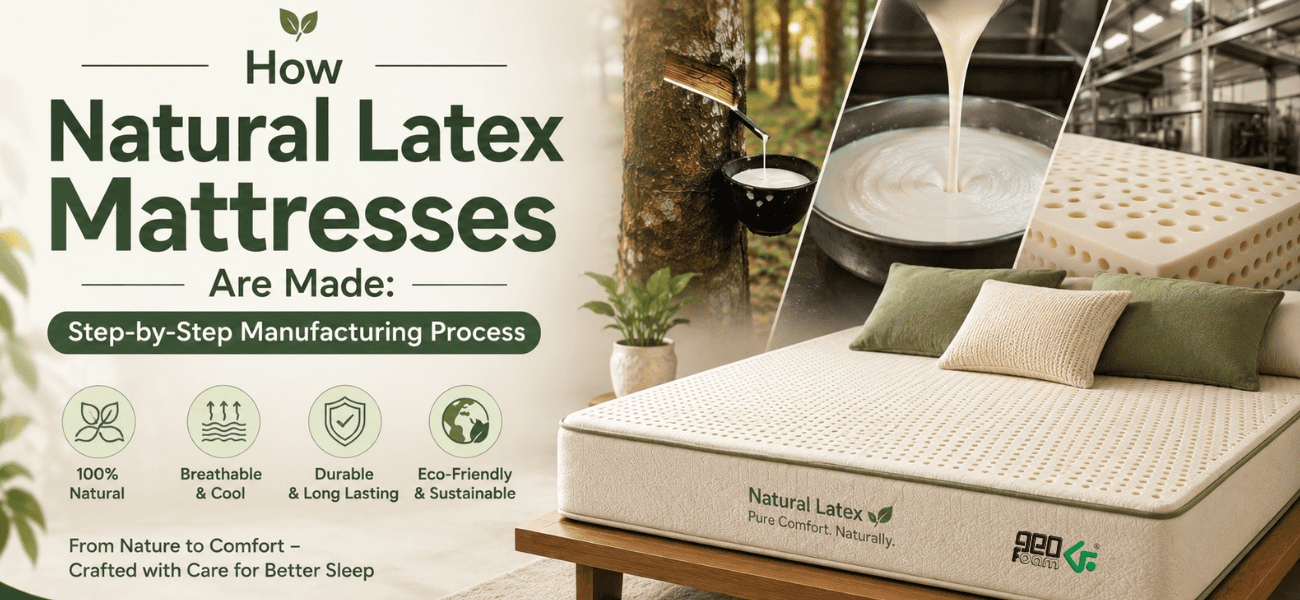
How Natural Latex Mattresses Are Made: Step-by-Step Manufacturing Process
When you sleep on a natural latex mattress, you’re resting on a product that has travelled an extraordinary journey from a living rubber tree to an expertly engineered sleep surface. Unlike synthetic foam mattresses made from petroleum-based materials, natural latex comes from a renewable resource and undergoes a carefully controlled manufacturing process that gives it its exceptional comfort, durability, breathability, and resilience.
Here’s a step-by-step look at how a natural latex foam mattress is made.
Step 1: Harvesting Latex from Rubber Trees
Natural latex comes from the Hevea brasiliensis, commonly known as the rubber tree. These trees grow in tropical regions, with countries such as Thailand, Indonesia, Malaysia, Vietnam, and India producing much of the world’s natural latex.
A rubber tree takes around six to seven years to mature before it can be tapped. Skilled workers make a shallow diagonal cut in the bark, allowing the milky white latex sap to flow into collection cups. Since only the bark is cut, the tree remains healthy and can continue producing latex for 25 to 30 years, making it a highly renewable raw material.
Rubber plantations absorb carbon dioxide, support biodiversity, and provide long-term livelihoods for farming communities, making natural latex a more sustainable choice for environmentally conscious consumers.
Step 2: Collecting and Preserving the Latex
Fresh latex naturally coagulates when exposed to air, so it must be preserved soon after collection. Small amounts of approved preservatives, typically ammonia, are added to stabilise the latex during transportation.
At the processing facility, the latex is filtered to remove natural impurities such as bark particles before moving to the next stage. At this point, it still resembles a thin, milky liquid.
Step 3: Transforming Latex into Foam
The filtered latex is mixed with carefully controlled ingredients that help stabilise and cure the foam. Air is then whipped into the liquid, creating millions of tiny air bubbles.
These microscopic air pockets form the characteristic open-cell structure of natural latex, allowing excellent airflow throughout the mattress. This is one of the reasons natural latex sleeps cooler than many conventional foam mattresses.
Step 4: Moulding the Mattress Core
The aerated latex foam is poured into specially designed aluminium moulds fitted with hundreds of vertical pins.
These pins perform several important functions:
- Allow heat to reach the centre of the mould during curing.
- Create the distinctive pinhole pattern found in latex mattresses.
- Improve airflow throughout the mattress.
- Help create ergonomic comfort zones by varying pin size and spacing.
Some premium latex mattress use these zones to provide softer support beneath the shoulders and firmer support under the hips, helping maintain proper spinal alignment.
Step 5: Vulcanisation
The filled moulds are heated in a controlled oven through a process known as vulcanisation.
During vulcanisation, the rubber molecules form strong cross-links, permanently transforming the liquid latex into a resilient foam. This process gives natural latex many of its defining qualities, including:
- Excellent elasticity
- Long-lasting durability
- Responsive support
- Superior pressure relief
- Shape retention
Without vulcanisation, latex would remain soft and unstable instead of becoming a durable mattress core.
Step 6: Washing and Drying
After curing, the latex core is removed from the mould and thoroughly washed to remove residual processing materials and excess natural proteins.
The core is then dried under carefully controlled conditions until it reaches the desired moisture level. Proper washing and drying contribute to the cleanliness, durability, and long-term performance of the finished mattress.
Step 7: Quality Inspection
Every latex core undergoes detailed quality testing before becoming a finished mattress.
Manufacturers inspect each core for:
- Firmness consistency
- Density
- Dimensional accuracy
- Structural integrity
- Surface quality
- Airflow characteristics
Only products that meet strict quality standards proceed to the final assembly stage.
Dunlop vs Talalay: Two Manufacturing Methods
Natural latex mattresses are generally manufactured using either the Dunlop or Talalay process.
The Dunlop process is the original and most widely used method. After the latex is whipped into foam, it is poured into moulds, vulcanised, washed, and dried. The result is a denser, slightly firmer foam known for its durability and excellent support.
The Talalay process adds vacuum expansion and flash-freezing before vulcanisation. This produces a lighter, softer, and more uniform foam. While both methods produce high-quality latex, Talalay is more complex and expensive to manufacture, whereas Dunlop is often preferred for its durability, sustainability, and robust support.
Also Read: Why a Natural Latex Mattress Is the Right Choice This Monsoon
Why the Manufacturing Process Matters
Every stage of production contributes directly to the performance of a natural latex mattress. From careful harvesting and precise foaming to vulcanisation, washing, and quality testing, each step is designed to maximise comfort, durability, breathability, and support.
The result is a mattress that offers cooler sleep, responsive pressure relief, excellent longevity, and year-round comfort.
Final Thoughts
From a drop of milky sap collected from a rubber tree to a premium mattress designed for years of restful sleep, the journey of natural latex is a remarkable blend of nature and engineering.
Whether you’re looking for superior durability, healthier sleep, or a more sustainable alternative to conventional foam, understanding how natural latex mattresses are made makes it easy to see why they remain one of the finest sleep solutions available today.
Also Read: Why a Natural Latex Mattress Is the Right Choice This Monsoon