
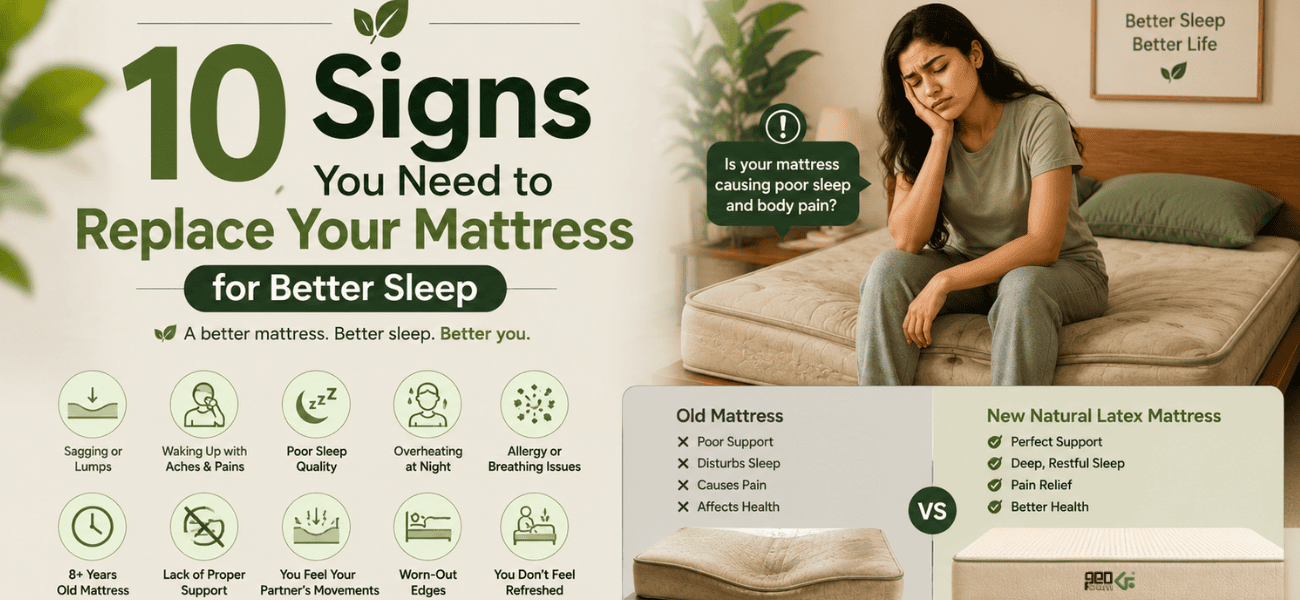
10 Signs You Need to Replace Your Mattress for Better Sleep
If you’re waking up sore, overheated, sneezing, or sleeping better on other beds, your mattress has likely passed its functional lifespan. Most mattresses last 5–10 years — natural latex mattresses last 12–20 years, roughly double, because the material resists sagging, heat retention, and dust mite growth by design.
Most people replace their mattress years too late — not because they can’t afford a new one, but because the decline is gradual and easy to explain away. Below are the 10 clearest warning signs, followed by what actually fixes each one.
1. You Wake Up with Aches and Stiffness
Persistent back, neck, or shoulder pain that eases within an hour of getting up is a classic sign your mattress has stopped supporting spinal alignment. Worn foam and springs create pressure points, forcing your muscles to compensate all night.
→ If this is your main symptom, see our guide to the best mattress for back pain for firmness and support recommendations.
2. Visible Sagging or Permanent Body Impressions
Check for dips of 1–1.5 inches or indentations that don’t spring back after you get up. A healthy mattress recovers its shape instantly; sagging means you’re sleeping in a hollow that misaligns your spine.
3. Constant Tossing and Turning
Shifting positions every 20–30 minutes to get comfortable signals uneven or failing support. This fragments your sleep cycle and prevents you from reaching deep, restorative sleep stages.
4. You Sleep Better Away From Home
If you consistently wake up more refreshed at a hotel or a friend’s house, your own mattress is the weak link in your sleep setup. Track it over 2–3 trips before concluding — one good night elsewhere isn’t proof, but a pattern is.
5. Springs Are Squeaking or Poking Through
For innerspring mattresses, exposed coils, creaking, or springs you can feel against your body mean the padding has eroded and the structure has failed mechanically. This is not fixable with a topper.
6. You Feel Every Movement Your Partner Makes
Worn springs and degraded foam transfer motion across the whole surface instead of absorbing it. If your partner’s movement jolts you awake, motion isolation has broken down.
7. Worsening Allergies or a Musty Odour
Years of trapped dead skin cells, dust mites, and moisture can embed microbial growth deep in the core — often producing a musty smell that survives even a deep clean. For allergy sufferers, this is a strong signal to replace rather than clean.
8. You Wake Up Overheated
Synthetic foams absorb and trap body heat, and ageing materials lose breathability over time. If you’re regularly hot and sweaty despite a cool room, poor airflow in your mattress core is likely the cause.
→ Related: How Latex Mattresses Keep You Cool
9. The Edges Are Collapsing
If you feel like you’re sliding off when sitting at the edge of the bed, edge support has failed — reducing usable sleeping surface and making it harder to get in and out of bed comfortably.
10. Your Mattress Has Reached (or Passed) Its Expected Lifespan
Even a mattress that “looks fine” loses resilience with age. Lifespan varies significantly by material:
Mattress Type | Typical Lifespan |
Innerspring | 5–8 years |
Memory Foam / Hybrid | 7–10 years |
Natural Latex | 12–20 years |
If your mattress is near the end of its bracket and you’ve checked off other signs above, it’s time to shop rather than patch.
Rule of thumb: if you checked 3 or more boxes, a topper or rotation is only a temporary fix — the underlying support layer needs replacing.
Why Natural Latex Solves Every Sign on This List
Problem | How Natural Latex Fixes It |
Sagging & body impressions | Resists compression for 12–20 years vs. 5–10 for spring/foam |
Poor support / tossing & turning | Instantly rebounds to shape — buoyant, not “sinking” |
Overheating | Open-cell structure allows airflow, dissipating body heat |
Allergies & odour | Naturally resists dust mites and mould |
Motion transfer | High-density latex absorbs movement at the source |
At GeoFoam, this isn’t a marketing claim — it’s been our manufacturing focus since 1975, sourcing natural rubber directly from Kerala and producing latex mattresses at our own facility in Ahmedabad. We’re happy to share our sourcing and manufacturing process in detail; see How Natural Latex Mattresses Are Made: Step-by-Step Manufacturing Process.
→ Compare all mattress types side-by-side in our Latex vs. Spring comparison guide. → Ready to shop? Contact us to buy Natural Latex Mattress and see range and pricing guide.